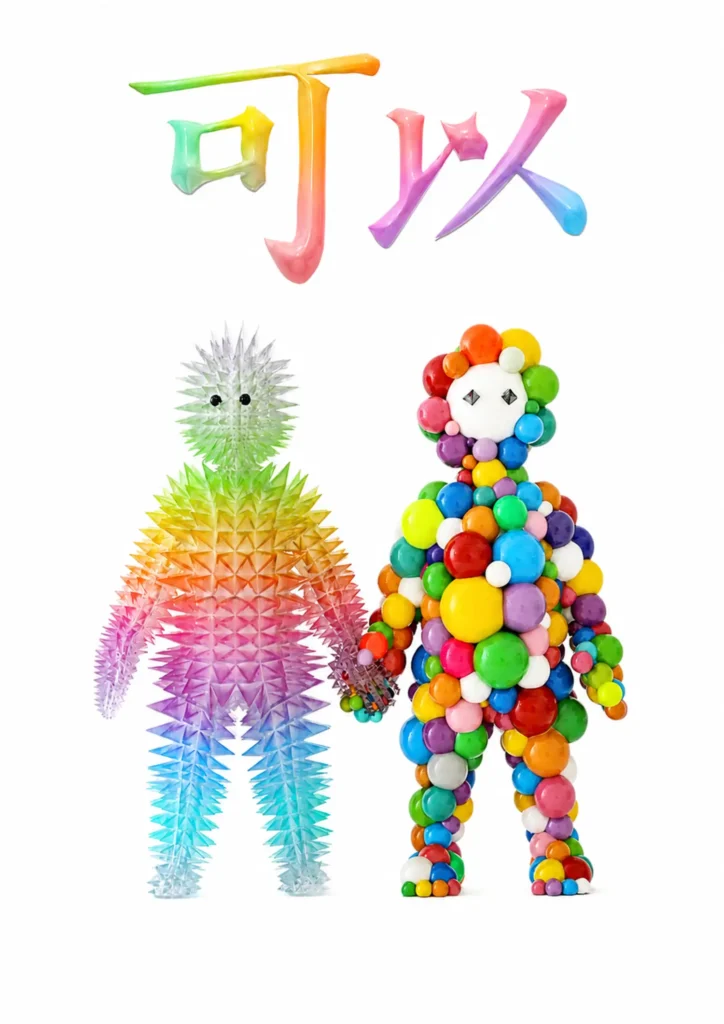
In a world where gray walls often dominate the urban landscape, Okuda San Miguel transforms them into vibrant universes of color, geometry, and meaning. Born Óscar San Miguel Erice in Santander, Spain, Okuda has become one of the most recognizable figures in contemporary urban art. His signature style an explosion of multicolored geometric patterns, surreal figures, and symbolic imagery blends the spirit of street art with the depth of fine art, exploring themes of existence, freedom, and the contradictions of modern life.
From his early graffiti along railway tracks in the late 1990s to monumental projects like the Kaos Temple in Asturias and large-scale sculptures across continents, Okuda’s work invites viewers into a dreamlike dialogue between color and gray, sacred and secular, tradition and modernity. His murals now adorn walls in over 20 countries, from India to Canada, Morocco to Chile, making him a truly global voice in the contemporary art scene.
Named among the most recognized urban artists of his generation, Okuda continues to challenge perceptions of space, spirituality, and identity through his dynamic visual language. In this conversation, we delve into the origins of his distinctive aesthetic, the messages behind his kaleidoscopic creations, and his vision for the future of art in public spaces.
From the streets to monumental works across the globe, Okuda San Miguel has built an unmistakable universe of color, geometry and symbolism.
From Porsche and Polo Ralph Lauren to collaborations and creative encounters with Felipe Pantone, Vhils, Bordalo II, Cope2, Remed, Waone, Rosh333 & Smithe his work moves freely between art, architecture, fashion and contemporary culture.
For our latest cover story, we step inside Okuda’s world to talk freedom, identity, transformation and what comes next.
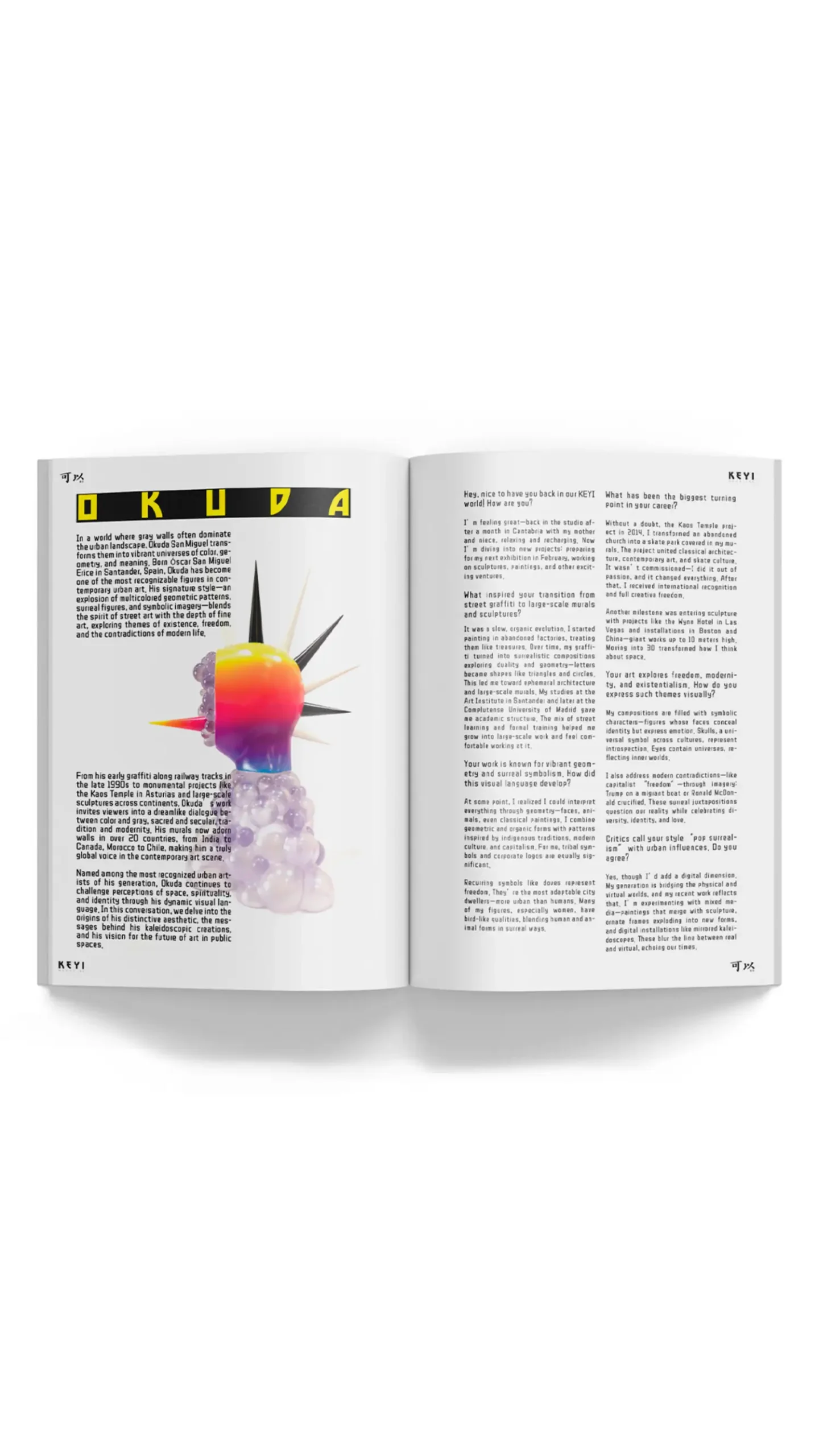
Hey, Nice to have you back in our KEYI world, How are you ?
Well, I’m actually feeling very good. I’m back in the studio, after spending a month on vacation with my mother, relaxing on the beach in Cantabria and taking care of my niece. Now I’m back to work, with lots of projects on the go, including preparing for my next exhibition in February, working on new sculptures and paintings, and several other projects that we’re currently very excited about.
What inspired your transition from street graffiti to large-scale murals and sculptures?
What inspired my transition from street art or graffiti to large murals? I think it was a very slow and organic evolution. I learned from the streets, from abandoned factories and other abandoned places, which for us were true treasures. It was there that I began to develop my first murals, moving beyond just graffiti to surrealistic compositions, exploring duality and geometry, especially with lettering. The letters themselves transformed into triangles, circles, and rhombuses. Then, gradually, this led to ephemeral architecture, incorporating elements like ambulances and other architectural forms. I also had formal artistic training, first at the Art Institute in Santander and later, from 1999 onwards, at the Complutense University of Madrid, where I completed my degree in Fine Arts. I believe that both these experiences, both the street learning and the academic training, have gradually helped me develop my career in large-scale murals and large-scale productions, and have made me feel comfortable working in that format.
Your work is instantly recognizable for its vibrant geometric forms and surreal symbolism. How did you develop this visual language?
I think, or rather, there came a point when I realized that you could apply geometric shapes to everything you saw. I started by transforming everything into triangles—animals, faces, etc. Then I started reinterpreting classic paintings, not just the art itself, but also the figures and themes of classical art, and giving them a more personal, contemporary twist. It’s a combination of geometry and organic elements, along with patterns that draw inspiration from indigenous and ancestral traditions, as well as from modern culture and even capitalism. I believe that indigenous patterns and designs are just as important as the logos of major brands that dominate our cities, and I think all of this is reflected in my artwork.
Regarding symbolism, I would say that what stands out in my work is the frequent appearance of many doves and other birds, especially doves. This is because the dove is the animal that has adapted most successfully to city life; it’s almost an “urban animal,” more adapted to city life than humans themselves. That’s why doves always appear in my work, often depicted as free, unfettered, symbolizing freedom—the most free character in my compositions. In fact, the women in my artwork often have bird-like features, almost like bird-women. Human figures also frequently appear with animal faces, not just bird faces. I think this surrealism and symbolism is very special and unique.
Looking back, what do you think has been the biggest turning point in your artistic career?
I think there’s a moment in my career that I always talk about, and it was a turning point. It was when I decided to develop this project, and above all, because I fell in love with the place, the church, El Caos Temple. It’s a project that I think was from 2014. I saw it online and I noticed the similarity between the ramps on the floor and the domes of the church. Then I fell in love with the place, so I researched it, and the guys who run it, who are a skateboarding group, told me they didn’t have any money, but that they knew my work and that if I wanted to transform it, then we could do it. So we did it. Several brands helped us, many people contributed, and then the first project I did was not because I was hired to do it, but because I decided to do it. And I think it was a turning point in my career because it brought together three incredible worlds: classical architecture, contemporary language with my painting, skateboarding, and also something that was a sacred temple before, even though it was no longer used for religious purposes. Churches have always been places where art has been preserved throughout history, right? In the end, both the Church and the kings commissioned artists to create works of art; it’s where the history of art has been preserved. So I think there are several very special elements that made El Caos a unique piece. And I think from there I did a million interviews in one year. I already had many projects at that time, but from then on I had many more, and I could decide what to do and what not to do. I think that was a very, very significant change. I would also say that another change was when I decided to start making large-scale sculptures in public spaces. The first one we did is at the Wynn Hotel in Las Vegas, which was for the Beautiful Music Festival in Las Vegas. Then, from there, we did seven sculptures in the Seaport in Boston, and then after the pandemic, we did three cities in China. I haven’t even been able to visit them yet, but I plan to. Three cities in China with three sculptures up to 10 meters high. I think that this is also a major milestone in my career, and moving into 3D, these large structures, these large sculptures, I think that has also been a turning point.
Many of your pieces explore themes like freedom, modernity, and existentialism. How do you translate such complex ideas into color and shape?
If my compositions attempt to address several themes, or to provoke reflection on various contradictions and concepts—existentialism, freedom, modernity, or the false freedom imposed by the capitalist system we live in—I think that’s conveyed through the characters. These are the characters who wander through my pieces, interacting with each other, expressing emotions, but whose faces, at the same time, don’t reveal their individual identities. There are also different levels of characters; there are those who I call “teams,” small groups that act as guardians of the souls of the main characters. Then there’s the skull, which is very present, because I believe it’s something that all ancestral cultures and all art throughout history has represented. And I think that in all my periods of creation, I’ve always had my own interpretation of the skull. It’s like delving into your own inner self. All the characters’ eyes contain the universe within them. I think that with all these elements and symbols, one can understand or be prompted to reflect on these universal themes: love, gender identity, cultural and gender diversity…
Several of the reinterpretations of classic artworks, such as the nude woman with male genitalia. I also think that all these multicultural motifsthe interactions between different characters, and the inclusion of real-life figures that reality compels me to incorporate for example, right now I’m looking at one of my largest pieces: Trump on a migrant boat, and Ronald McDonald crucified. Well, I think all of this speaks to these symbols and these concepts.
Critics describe your style as “pop surrealism” with urban art influences. Do you agree with that label? How would you describe your own style?
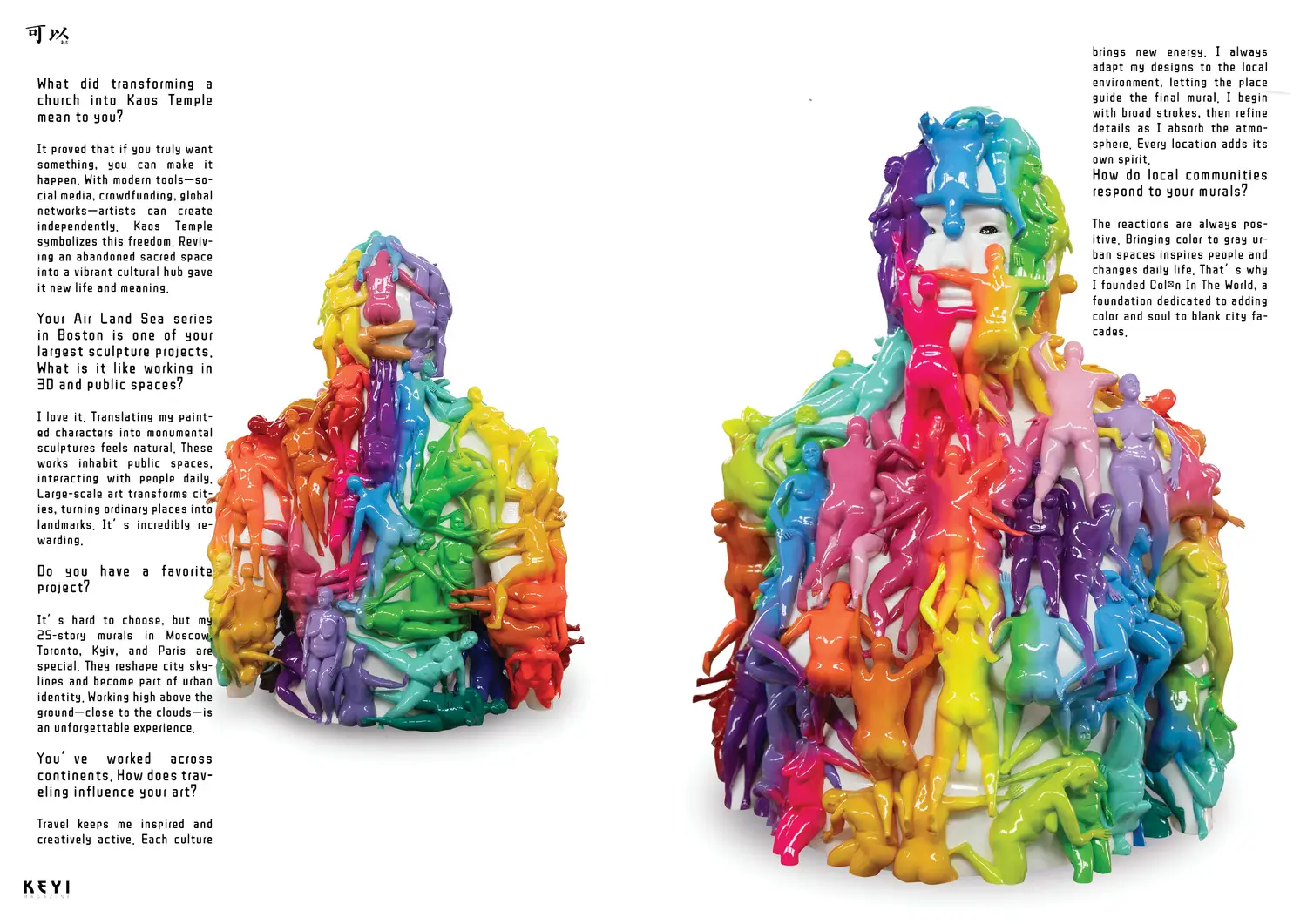
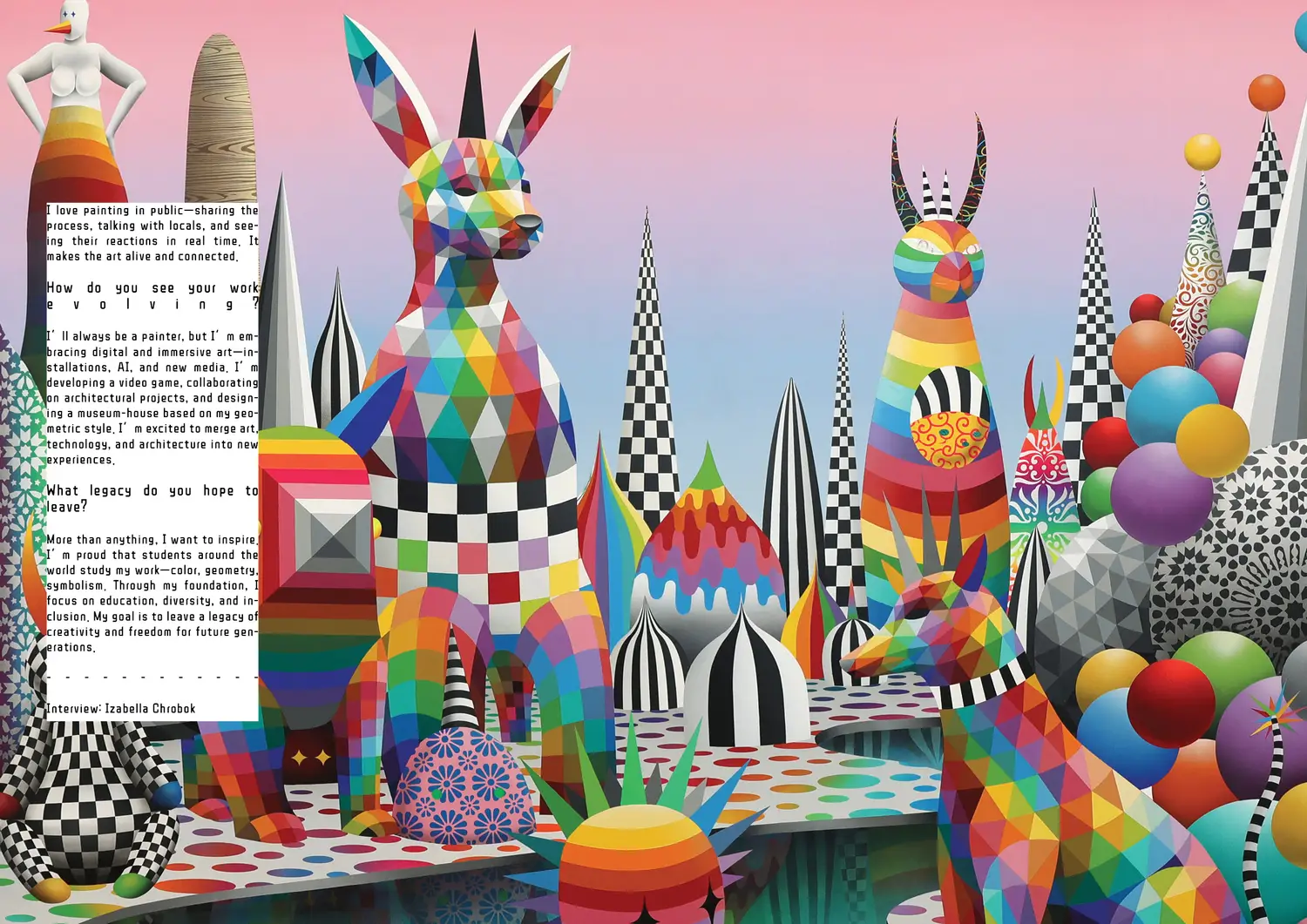
If I can agree with this description, it’s like a pop realism with a strong connection to street art, with a lot of inspiration from the street, yes, that could be it. But I also think that now it could be said that it’s almost a digital language as well. This is because, ultimately, we are now immersed in a new way of communicating, a more virtual world is coming, and my generation is the one experiencing the transition from the physical world to the virtual world. So, I think my latest works also speak to this, not only in the compositions and concepts, but also in the technique and the medium itself. In my last two exhibitions, what I present is a construction of my work, which is why I have arrived at new formats. There are kind of sculptures that emerge from the wall, which in the photo you can’t quite tell if they are digital or real, but they are actually real. In these same sculptures, I use a wide variety of materials: fiber, metal, metal spikes, mirrors, frames the frames of classic, ornate paintings are part of the composition, appearing as if they are an explosion of the painting itself. It’s a kind of middle ground between painting and sculpture, between collage and something else, between the physical world and the virtual and digital world, in a way. Or also with the more digital pieces, like the kaleidoscope. It’s a triangular mirror tunnel with a screen at the back, which is a journey through my work, from my early graffiti pieces to the most recent ones, but all multiplied infinitely by the mirrors in this kaleidoscope, kind of like those kaleidoscopes we had as children. I think I’m at my best right now, and I think the work reflects this, this kind of explosion, this transition from this world to the virtual world.
The Kaos Temple project brought you international recognition. What did it mean for you to transform a church into a space for art and skate culture?
I think that Caos Temple, more than anything, represented a change in my perspective, but above all, for me, and I think for everyone, it made it very clear that “if you want to, you can.” Today, an artist has all the tools at their disposal to do whatever they want, without depending on anyone, or often without even knowing who will pay for it or where the funding will come from. In other words, the good thing about modern times, with social media, online platforms, and all the ways we can connect whether to find projects, secure funding, or communicate is that it gives artists absolute freedom. If we know how to use these tools, we can create without limitations. Caos Temple is a symbol of this new way of working, this new way of composing or creating without boundaries. Your canvas isn’t just in your studio or only in cities and buildings; it can also be inside a church, transforming the entire space to create a new type of artwork and a new cultural space, open to all kinds of possibilities. And giving life to a completely abandoned place that in itself is valuable, a truly great value.
I’ve been working with large-scale pieces my whole life. I start with smaller pieces in the studio, but I think it’s very special to take these characters from my paintings and transform them into large-scale sculptures for public spaces. For me, it’s a perfect match, and I absolutely love this format. I feel very comfortable with it, and I think it’s what people are most interested in seeing from me.
Your Air Land Sea series in Boston is one of your largest sculpture installation. What challenges and opportunities come with working in 3D and in public spaces?
I think, as I mentioned before, that large-scale sculptures today are, in a way, a continuation of those early pieces, like the one in Sheila Boston and the bear sculpture in Las Vegas. From those initial projects, I’ve received many proposals for large-scale sculptures in public spaces. And today, the projects we’re working on are precisely this type of large-scale artwork for public spaces. I feel very comfortable with this format, since I’ve been working with large-scale pieces my whole life. I start with smaller pieces in the studio, but I think it’s very special to take these characters from my paintings and transform them into large-scale sculptures for public spaces. For me, it’s a perfect match, and I absolutely love this format. I feel very comfortable with it, and I think it’s what people are most interested in seeing from me.
Do you have a favorite mural or project that holds special meaning for you or inspires you? Why?
I don’t think I could tell you a single favorite mural, but I can tell you several, and especially the larger ones. I have four murals around the world that are 25 stories high. I choose these because they add value to cities; they become part of the city’s identity, changing its skyline. They are incredible, and the feeling is wonderful. I experience this not only when I’m working on them, but also when I’m on the scaffolding. From 15 stories high and above, we don’t use cranes, but suspended scaffolding. I think the feeling of being close to the clouds, watching the sunsets, while working on these murals—a view that no one else sees—is amazing. And after completing the work, I think that this kind of monument to the city is fantastic. So, I would choose four: I have one in Moscow, 25 stories high, which I love; another in Toronto, another in Kyiv, and another in Paris. I think I would stay with these four large-scale, 25-story murals. I think they are the most impactful, especially because of their sheer size. They don’t overwhelm the city, but rather enhance it, changing its skyline.
You’ve painted murals and exhibited works across continents from Morocco to Canada, India to Chile. How does working in different cultures affect your artistic process?
I think the most rewarding aspect of my work isn’t just creating on a large scale, but also the constant travel and the opportunity to learn from different cultures in the various countries I visit. All these places inspire me and keep me very connected to my creativity; in fact, traveling keeps me constantly generating new ideas and keeps me very creatively active.
Also, I should say that I like to have a preliminary sketch, especially if it’s for a government, an institution, or a large brand. Usually, the sketch is sent months in advance, but I always like to travel to those countries, to those places, to experience the environment firsthand, so that the architecture and the surroundings themselves inspire me and guide the development of the artwork. In other words, the final mural is never exactly the same as the initial sketch. I always like to embrace the present moment and keep the work evolving. I start by sketching the main elements or the composition with a long stick and a brush, moving from the general to the specific, from the larger to the smaller details. Then, the artwork itself guides me through the next steps and the small details I add later. I like to keep the work dynamic and, above all, to feel the spaces and places, and to sense the culture of those places, as that inspires me to create one thing or another.
How do local communities respond to your work, and how important is that interaction for you?
What I’ve seen when I’ve traveled to countries so different from Europe is that the feedback has always been wonderful, because in a way, it’s like leaving a part of my heart in those places, for example, in India or Africa places that are perhaps a bit more architecturally run-down. I don’t think it’s about the place itself; it’s about the amazing life experiences, the smiles, and the positive feedback from the people who live in those environments. Ultimately, it’s about adding color, combating the grayness of concrete, and the monotony of these buildings. I believe that inspiring the people who live there is wonderful, and that’s why, some time ago, I created my own foundation, Colón In The World, which is all about that: trying to bring color to the world and fight against the grayness of large, impersonal buildings that often have blank facades with no windows like giants that seem to have no soul. It’s so much better when there’s art on them, isn’t it?
And I think it’s also very interesting that he’s used to showing the entire process, not just on social media, but also when he’s painting his murals in public spaces. He’s comfortable with people seeing the entire process. That’s why I also like to show many of the processes involved when I create my studio work. In a way, it’s like showing your work to the world, from beginning to end, in its entirety. I think that’s very interesting because you also interact with the people who are around while you’re working, and you hear their feedback. I think it’s wonderful to create art while engaging in conversation with the people who live in those spaces. I think that’s very important and very interesting.
How do you see your work evolving in the coming years?
For the past few years, I’ve seen my work evolving towards a more virtual, more digital language. It’s not that I’ll ever stop being a painter—a “Renaissance painter,” if you will—but with the new tools available to us in contemporary art, such as artificial intelligence and technology, in addition to painting, sculpture, and embroidery, which I’ve been doing for a while now, I believe that installation art is what motivates me most, especially when incorporating technology and exploring more experimental and immersive approaches. I feel I’m definitely moving in that direction, and I’m very comfortable with it. So, looking ahead, I see myself exploring new areas, like creating my own video game, which I’ve been working on for three years now. I’m also working on my first architectural project with an architect, where I’ll use my geometric style to design a museum-house and studio. And then there’s another architectural project, which involves creating unique, habitable spaces. I think my path encompasses many different, complementary directions, and I’m very happy with where I am now and where I’m going. I’m very happy with this.
What legacy do you hope to leave through your art?
The most important thing about an artist with a unique identity is the legacy they leave behind, and I’m very proud, especially because I receive messages from so many schools, not only in Spain but also in many other countries. These messages come from children, teenagers, and even university students who study my work, who study color theory, and who study geometry. As part of my foundation, I visit many schools, and many schools also come to visit us at our studio. I believe that, through my foundation, we are very focused on education, particularly on promoting diversity and inclusion. I think this gives me great pride, knowing the legacy I am leaving, especially for future generations.
Interview by Grzegorz Bacinski
Our next event : Phantom Bar – 26.09.2026 Get Your Reduced 30% Off TICKETS
Check more music related articles here.